
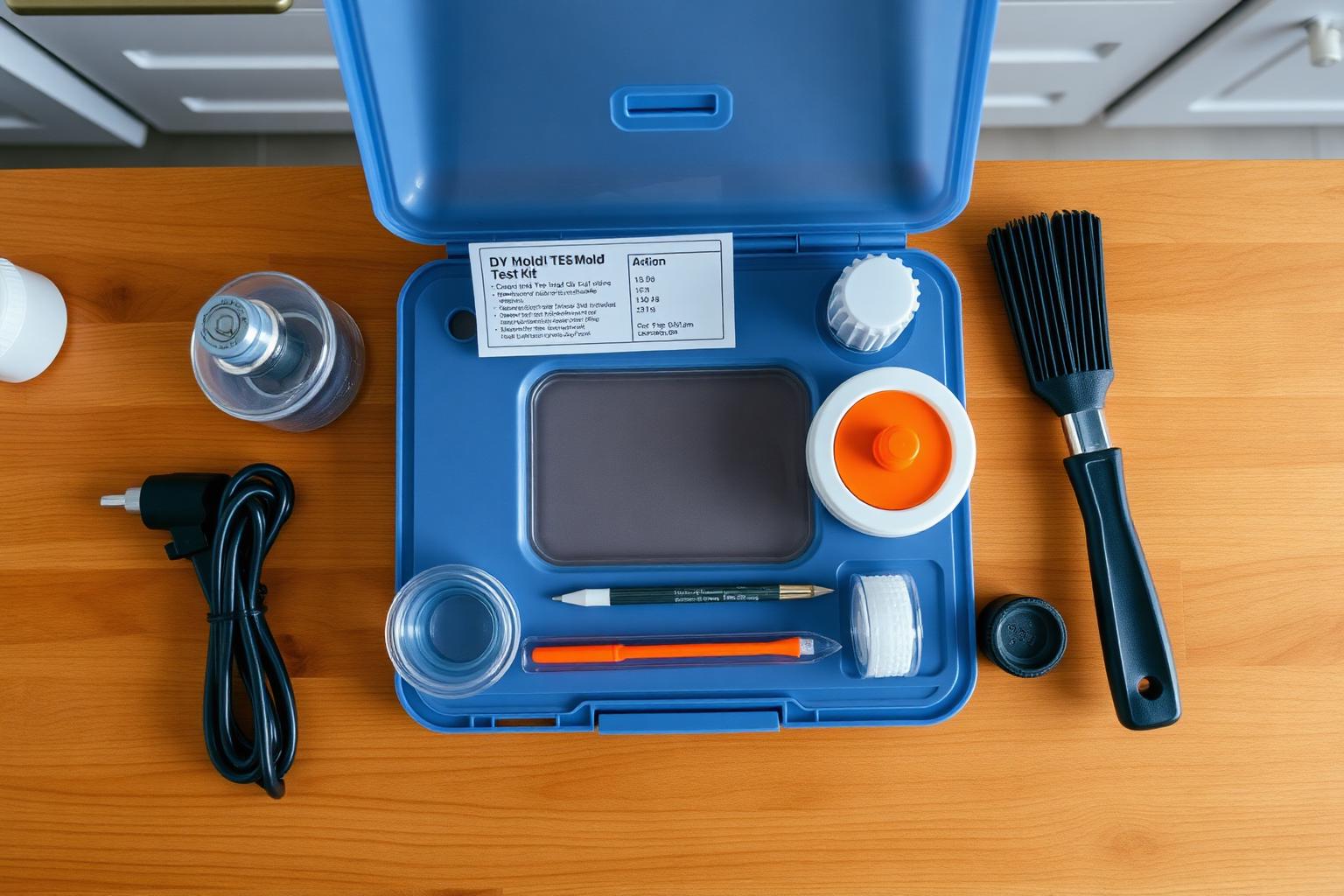
You can buy a mold test kit at Home Depot for under $20. So why would anyone pay for professional mold testing? It's a fair question. Here's the honest answer.
How DIY kits work
Most home mold kits use a petri dish with growth medium (called a settle plate). You leave it open for an hour or two, close it, and incubate it for several days. If mold colonies grow, you've "detected mold."
Why they're nearly useless
**Problem 1: They always show mold.** Mold spores exist in every indoor environment on Earth. A settle plate left open in any home will grow something. The result tells you nothing about whether your specific home has a problem.
**Problem 2: They can't compare to outdoor baseline.** Professional testing always includes an outdoor control sample. Without that comparison, indoor spore counts are meaningless. A "high" indoor count might actually be lower than outdoor air.
**Problem 3: They don't quantify.** A petri dish shows you that *some* spores were present. It doesn't tell you how many — and concentration is what matters.
**Problem 4: They miss hidden mold.** A settle plate captures only spores actively floating in air at that moment. Mold growing behind a wall releases very few spores into the room — until it's disturbed. Many serious contamination cases would show "normal" results on a DIY test.
**Problem 5: Species identification is limited.** The growth medium used in consumer kits favors certain species and suppresses others. You'll never know what's actually in your home.
**Problem 6: There's no analysis or context.** Even if you mail the sample to the lab option some kits offer, you receive a list of spores with no interpretation, no understanding of your home's specific situation, and no remediation guidance.
Where DIY kits cause harm
We've inspected homes where families spent months not addressing serious mold problems because a DIY test "came back fine." We've also inspected homes where families spent thousands on unnecessary remediation because a DIY test "showed mold" — when actually nothing problematic was happening.
Both outcomes hurt people. Bad data is worse than no data.
What professional testing provides
A proper mold inspection includes: - **Visual assessment** by a trained inspector - **Moisture mapping** to find hidden water - **Thermal imaging** to identify problem areas - **Calibrated air sampling** with indoor and outdoor controls - **Accredited lab analysis** with species identification and spore counts - **Interpretation in context** of your specific home - **Remediation guidance** based on findings
When DIY testing makes sense
Honestly? Almost never. The only situation where a DIY kit might add minor value is curiosity — "I just want to see if mold grows in my closet." For any decision-making purpose (health concern, real estate transaction, insurance claim, remediation planning), professional testing is the only reliable approach.
**Considering testing your home?** Skip the hardware store. Call HBH at (631) 774-6502 for an inspection that actually gives you usable information.
Keep Reading
Home Systems
Bathroom Mold Prevention: A Long Island Homeowner's Guide
Bathrooms are ground zero for mold in Long Island homes. Here's how to stop it before it starts — from ventilation to grout.
Seasonal
The Long Island Fall Mold Prevention Checklist
Autumn is the most important — and most overlooked — season for mold prevention on Long Island. Use this checklist before winter sets in.